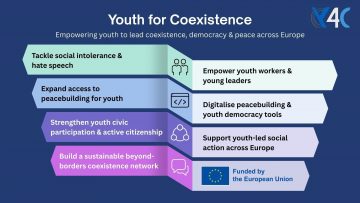
Youth for Coexistence – objectives

As the year comes to an end and the holiday season fills our feeds and conversations, it’s important to remember that coexistence doesn’t happen by chance — it’s built through participation, dialogue, and action. Across Europe, young people are increasingly exposed to social intolerance and digital hate speech during the holiday period, when online spaces … Continued
What’s inside the Y4C Youth Work Curriculum?

What’s inside the Youth for Coexistance Youth Work Curriculum? Our curriculum is built around 6 educational and practical modules designed to equip youth workers, young leaders and the wider youth/educationalist sector with practical tools for coexistence and peacebuilding: Step by step, we’re building tools for a more inclusive Europe. Funded by the European Union. The … Continued

Youth for Coexistence – why it matters?

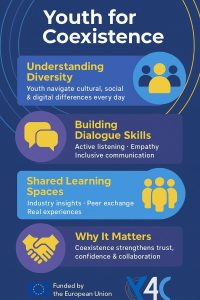
In multicultural cities and digital spaces where differences meet every day, coexistence isn’t just a value, it’s a skill. And like every skill, it takes practice, knowledge, and the right support system. That’s why initiatives like Youth for Coexistence (Y4C) matter. We’re creating spaces where young people, youth workers, and community leaders can share industry insights, exchange … Continued

Call for participants: Training Course PLAYADR in Hungary

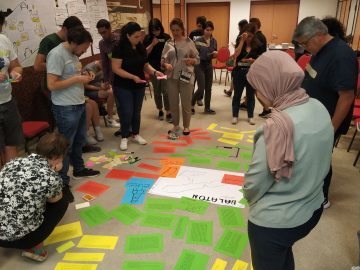
The project PLAYADR: Promoting Learning in ADR through Youth-oriented Playful Approaches aims to equip youth workers with the knowledge and skills to use games and educational tools to teach Alternative Dispute Resolution (ADR) concepts to young people. The training course will be organised 8-16 August 2024 in Hollókő, Hungary. ADR stands for Alternative Dispute Resolution. … Continued

IOGGA2 Training Course Successfully Implemented: Empowering Gender Awareness and Fostering Unity

We are thrilled to announce that the IOGGA2 project has officially been implemented in Hungary at the end of May! This transformative training course aimed to enhance gender awareness in activities involving youth from diverse social actors in Europe and third countries. During the first day, participants from Albania, Azerbaijan, Estonia, Hungary, Italy, Spain, and … Continued

Gender inequality and the COVID-19 crisis

According to the United Nations Human Development Working Paper on ‘Gender inequality and the COVID-19 crisis: A Human Development perspective’, women are disproportionately affected by the Coronavirus Pandemic. The paper explains how ‘women make up more than 85% of nursing personnel and women make up almost half of doctors for all countries except those with … Continued

All writers' views in articles are their own and do not necessarily represent the opinion of the AsfarEurope team.

Published by AsfarEurope in London, UK - ISSN 2055-7957 (Online)